How long do braces take? The stages of orthodontic treatment
How long braces take, the stages of a course of orthodontic treatment, what makes it longer or shorter, and how to keep your treatment on schedule.
"How long will I need braces?" is the question almost everyone asks before starting. The honest answer: it depends on you. Most courses of treatment take somewhere between one and a half and two and a half years; some are shorter, some longer. This article explains the stages of treatment, what makes it longer or shorter, and what you can do to keep yours from dragging on.
The stages of orthodontic treatment
Most treatments go through the steps below. The order and length of each step depend on your teeth.
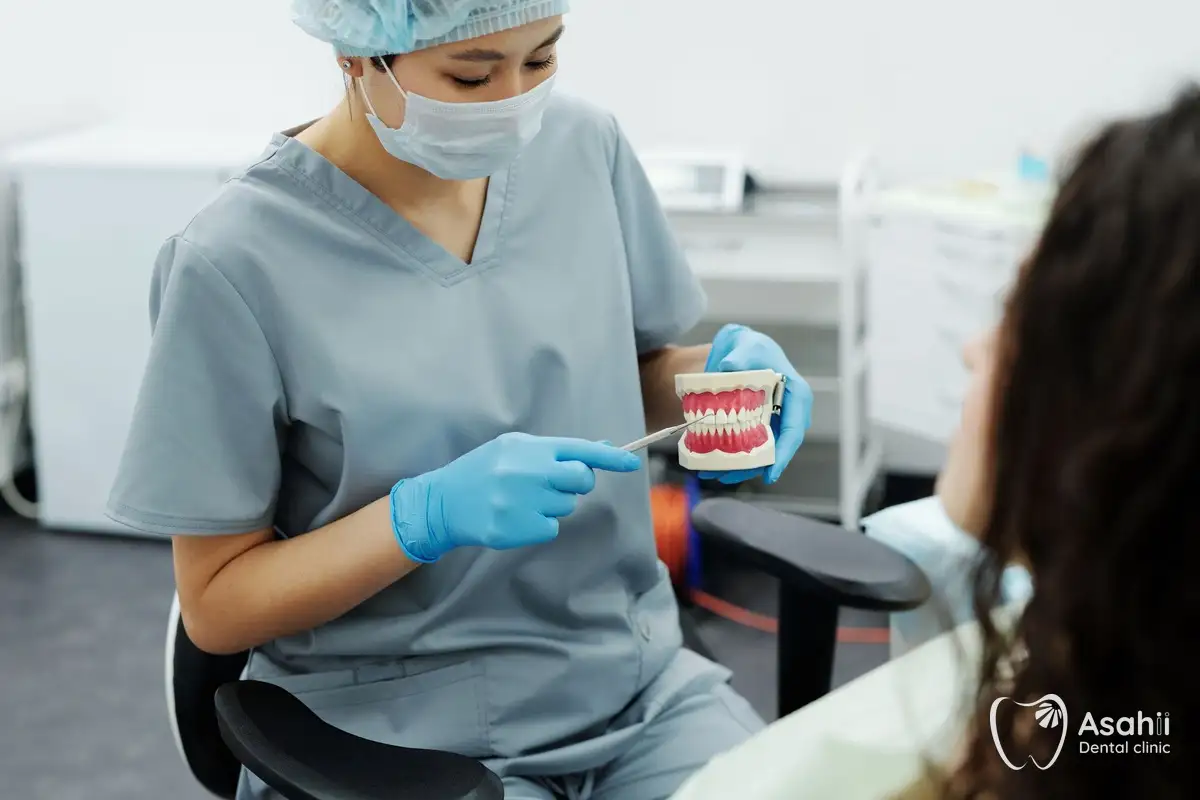
The dentist explains the stages of orthodontic treatment on a jaw model
Examination and planning
Your orthodontist examines your mouth, takes a panoramic X-ray and a lateral cephalometric X-ray, photographs and an impression or a digital scan. From these they analyse your bite, decide which teeth need to move and choose the appliance. The plan is explained to you before anything starts, with an estimated duration. At Asahii Dental Clinic this step is done for each patient by Dr. Chu Thuy Trinh, the clinic's medical director and orthodontist: the plan is written down item by item with its costs, and you read it, ask your questions and confirm before the appliance goes on.
Preparation before the appliance goes on
Teeth need to be clean and any existing problems treated first: decay, gum inflammation, tartar. Some cases need extractions to make room, or expansion of the jaw. This step lets teeth move on a healthy foundation.
Fitting the appliance and aligning the teeth
With fixed braces, brackets are bonded to the teeth and an archwire is placed. With clear aligners, you receive your first set of trays. In the first months the teeth are levelled and aligned along the arch. This is when you see the most visible change.
Closing spaces and correcting the bite
Once the teeth are aligned, the orthodontist closes gaps (especially after extractions) and corrects the relationship between the two jaws. This stage is usually the longest and the least visible, which is why many people get impatient. It is also what decides how well you will chew for years to come.
Finishing and removing the appliance
In the final months each tooth is fine-tuned into position and the bite is checked in several positions. Then the appliance is removed and the teeth cleaned.
Wearing retainers
Taking the braces off is not the end. Teeth tend to drift back, so you need to wear retainers as instructed. See After braces: why retainers matter.
What makes treatment longer or shorter
Your starting point. Severe crowding, protrusion, an underbite or a significantly misaligned bite usually take longer than mildly crooked teeth.
Extractions. Cases with extractions need extra time to close the spaces.
Age. In growing children the jaw is still developing and that growth can be used. Adults can be treated too, but teeth usually move more slowly.
Type of appliance. Each has its strengths; the duration depends far more on the case than on the appliance. Asahii offers metal and ceramic braces (including Damon self-ligating systems) as well as Invisalign clear aligners, including Invisalign First for children. See Metal braces, ceramic braces or clear aligners.
Keeping your appointments. Every visit is an adjustment. Miss several and the teeth stop moving while the months keep passing.
Your cooperation. Wearing elastics, wearing aligners for enough hours, keeping brackets intact: these small things add up to months.
A typical appointment schedule
With fixed braces you are usually seen every four to six weeks. With clear aligners visits can be further apart, because you change trays at home on a schedule. At each visit the orthodontist checks that the teeth are moving in the right direction, changes the wire or hands over new trays, and tells you what to do until next time. If you travel or are busy, let the clinic know in advance so visits can be planned rather than skipped. Asahii is open every day of the week, 08:30 to 19:00, so working patients can choose a weekend slot, and the clinic's Zalo Mini App sends automatic reminders before each visit.
Booking an orthodontic check-up, usually every four to six weeks
How to avoid a longer treatment
Keep every appointment. If you must move one, move it early rather than skipping it.
Wear elastics and aligners for the number of hours prescribed.
Avoid hard, chewy and sticky food that breaks brackets. One broken bracket can set that tooth back by weeks.
If something goes wrong (a loose bracket, a poking wire, a cracked tray), contact the clinic straight away instead of waiting for your next visit.
When to see us straight away
Pain that does not ease within a few days of fitting or adjustment.
A loose bracket or a wire cutting into your cheek or tongue that you cannot manage at home.
A tooth that is clearly loose, or gums that are swollen or bleeding a lot.
A cracked or broken aligner, or one that no longer fits.
Your own treatment time can only be estimated after a doctor has examined you and read your X-rays. See our orthodontics and braces page or book an appointment by hotline 0928 888 121, Zalo or the Mini App for advice on your own case.
Frequently asked questions
Do braces take longer for adults than for children?
Usually a little longer, because the jaw has stopped growing and teeth move more slowly. Most adults can still be treated, and the result is just as stable if retainers are worn properly.
Is there a way to speed up treatment?
The most effective way is to keep your appointments, wear elastics or aligners for the prescribed hours and keep your teeth clean. Orthodontists do not shorten treatment by increasing force, because excessive force can damage roots and bone.
Why has nothing seemed to change after a year of braces?
Closing spaces and correcting the bite is hard to see, but it is the stage that matters most for chewing. If you are concerned, ask at your next visit to see comparison photographs.
Is there anything to do after the braces come off?
Yes. You need to wear retainers as instructed and attend check-ups so the orthodontist can confirm the teeth are stable.
This article is general information reviewed by our dentist; it is not a diagnosis. Only an examination can say what your teeth need.
Was this article helpful?
Tap a star — 1 is not helpful, 5 is very helpful.
Thank you! Your rating helps us write better.
Could not send right now — please try again later.
A practical guide to oral hygiene with braces: the first days, food to limit, brushing around brackets, useful tools and what to do when a bracket comes loose.
What retainers are, why teeth drift back after braces, the types of retainer, how long to wear them, how to clean them and what to do if one breaks or is lost.
· 4 min read·
Book a visit
Book a orthodontics & braces consultation
Leave your phone number – our front desk will call you back to find a time that suits you.